
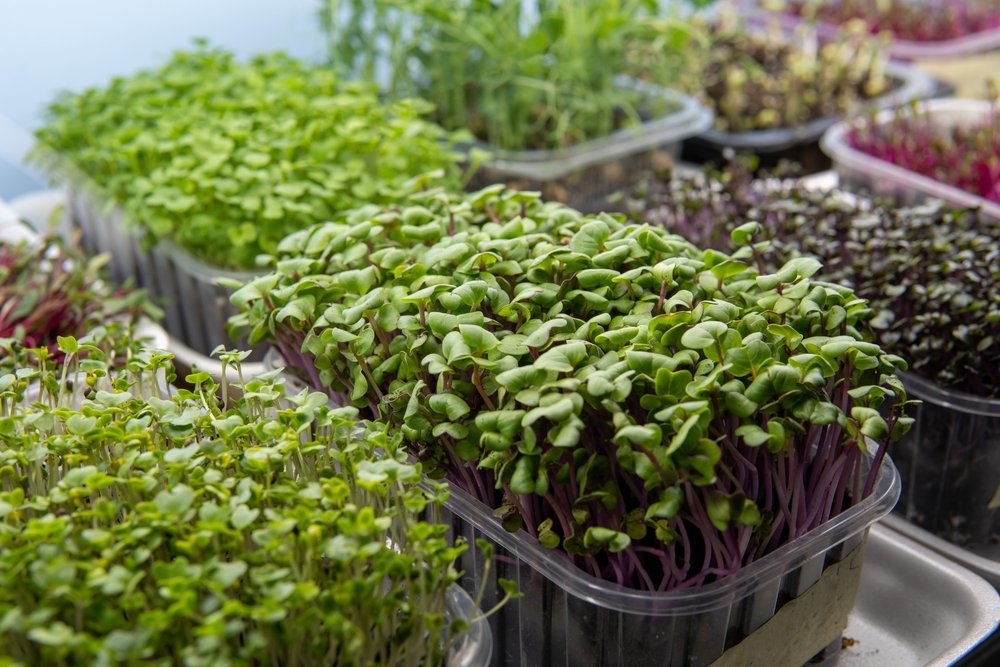
Microgreens vs Fast Food and Mature Vegetables: Nutritional Comparison Blog
Microgreens vs Fast Food (Per Serving)
| Nutrient | Microgreens (10g Radish)* | Cheeseburger (100g) | Cheese Pizza (100g) | French Fries (100g) |
| Calories | ~3 kcal | 226 kcal | 266 kcal | 296 kcal |
| Protein | 0.23 g | 11.3 g | 11.4 g | 3.0 g |
| Fat | ≈0 g | 12.4 g | 9.7 g | 15.0 g |
| Carbohydrates | 0.44 g | 17.3 g | 33.3 g | 37.0 g |
| Fiber | 0.22 g | 1.5 g | 2.3 g | 3.2 g |
| Vitamin A | 3.2 μg | 9 μg | 69 μg | – (approx. 0) |
| Vitamin C | 2.5 mg | 0.9 mg | 1.4 mg | – (approx. 0) |
| Vitamin E | – | – | 0.83 mg | – |
| Vitamin K | 25 μg | – | 6.7 μg | – |
| Iron | 1.59 mg | 3.0 mg | 2.5 mg | – (very low) |
| Calcium | 15 mg | 46 mg | 188 mg | – (trace) |
| Magnesium | 6.6 mg | 18 mg | 24 mg | – |
| Potassium | 30 mg | 188 mg | 172 mg | ~200 mg |
| Sodium | 1.1 mg | 342 mg | 598 mg | ~500 mg |
| Antioxidants | High | Very low | Low | Very low |
Sources: USDA-derived microgreens data ; McDonald’s and USDA/MyFoodData for fast foods.
Key Takeaway:
Microgreens offer essential vitamins and minerals at negligible calorie levels. In contrast, fast foods deliver high calories, fats, and sodium with minimal nutrient content. For example, just 10g of microgreens (3 kcal) provides ~2.5 mg vitamin C, while 100g of pizza (266 kcal) gives only ~1.4 mg. Microgreens are nutrient-dense per calorie, whereas fast food is calorie-dense but nutrient-poor.
Microgreens vs Mature Vegetables (Same Plant, Per 10g)
| Nutrient | Radish MG | Radish Root | Broccoli MG | Broccoli Veg | Pea MG | Peas (Green) |
| Vitamin A | 3.2 μg | 0 μg | 96 μg | 3.1 μg | 69 μg | 10.5 μg |
| Vitamin C | 2.5 mg | 1.48 mg | 9.3 mg | 8.92 mg | 4.0 mg | 1.0 mg |
| Vitamin K | 25 μg | ~0 μg | 93 μg | 6.7 μg | 22.5 μg | 2.4 μg |
| Folate (B9) | ~0 | 0.053 μg | 9.4 μg | – | 9.0 μg | 5.9 μg |
| Iron | 1.59 mg | 0.034 mg | 0.086 mg | 0.073 mg | 0.16 mg | 0.20 mg |
| Calcium | 15 mg | 2.5 mg | 7.8 mg | 4.7 mg | 13 mg | 2.4 mg |
| Potassium | 30 mg | 23.3 mg | 48 mg | 31.6 mg | 36.5 mg | 11.0 mg |
Sources: USDA FoodData Central and Nordamark lab results. MG = Microgreens.
Key Takeaway:
Microgreens generally contain 2x to 40x more vitamins and minerals than their mature vegetable counterparts. For instance: – Broccoli microgreens have 31x more Vitamin A than mature broccoli. – Pea microgreens contain 6x more Vitamin A and 5x more Calcium than peas.
Brassica family microgreens (radish, broccoli, mustard) are exceptionally rich in sulforaphane and glucosinolates, powerful compounds shown to prevent cancer and inflammation.
Conclusion
Microgreens are a nutritional powerhouse, significantly outperforming both fast food and even the mature vegetables they grow from. Including just 10–30g of a mix of microgreens daily can add valuable antioxidants, vitamins, and minerals to your diet—without the heavy calorie load or nutrient gaps found in processed foods.
Perfect for salads, smoothies, garnishes, or sandwich toppings, microgreens offer a smart and natural way to elevate everyday nutrition.
Sources: USDA FoodData Central, MyFoodData, peer-reviewed studies on microgreens from agricultural and nutritional science journals.
Note: Nutritional values may vary by variety and growing method.